




16 years ago
|
Showing posts with label Art. Show all posts
Showing posts with label Art. Show all posts
Color TransformsMonday, November 29, 2010
Color theory is about a-lot more than the color wheel we learned in first grade. In high-school art classes kids are often taught about color mixing with pigments, but beyond how to mix paint, what do we need to know about colors that isn't already obvious?
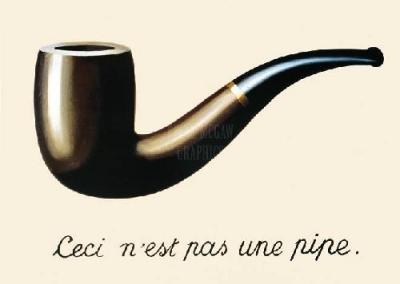
Rene Magritte's famous work "The Treason of Images" touches on how image can deceive. Color in this same way has the ability to trick the eye. The optical illusion below gives a simplistic hint at the potential color has in tricking the mind. The two labeled squares are actually the same color but they don't appear to be the same at all because of the context of the image.  Beyond context, color actually has the ability to change the way that other colors around it appear. A bright color surrounded by muted and unsaturated tones will pop out. Artists can utilize these tricks of color to convey a message. Making this kind of emphasis can really grab attention and say something to the viewer. Avant-GardeWednesday, October 20, 2010
This overused term puts a bad taste in my mouth. Heard at the most random of times, in the most random of places, why is this term still used? The time in history where this term had any usage and any meaning has passed with the turn of the century. Groundbreaking, rule-breaking, artistic boundary shattering artwork of the 20th century was Avant-Garde. Let's move from this personal vendetta to something rooted in reality.
a vant-gardeLets take a look at some "Avant-Garde" work of the 21st century. Of course, we don't use this outdated term to describe artists who fit into this category anymore, we use the word guerrilla. Guerrilla artists break laws to get their work out there, although they can tend to in creative ways, the lawbreaking is a consistent trend in guerrilla art. Here we find famous names like Banksy and zevs or group organizations like Retna and Wall Spankers who take the only Avant-Garde risks left to take.
If you are confused as to why criminals are getting artistic recognition, don't worry; you're not alone. Lovers of irony, eat your hearts out.  Creativity from WithoutSunday, October 10, 2010
Art in any form is often confused with self expression. There is often an assumption that when you're looking at an artist's work, you are peering into their soul. An artist's work is an outer expression of one's feelings, life, opinions, thoughts, emotion, past, or passions; isn't it?
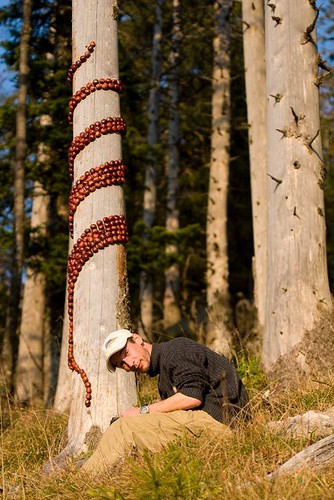
One creative artist, Sylvain Meyer, uses the term 'Land Art' to refer to his work with nature. Meyer's ephemeral designs have earned him quite a bit of recognition, and are reminiscent of the epic natural works of Andy Goldsworthy. The photo to the left shows Meyer in the process of creating one of his noteworthy pieces entitled "Enroulement Marron" or "Brown Swirl" in English. This piece was made out of brown chesnuts, which as Meyer says, are usually only picked up by children. In his works, Meyer is consistently remaining conscious of his effect on the environment around him, and is careful to use "eco-friendly" methods. Meyer's artwork brings to mind the simple play of a child. We all experienced something in the way of making our own mark in nature, whether it be a circle in the sand, a pile of stones, or twisting flowers together into a bracelet. Nature is something we can each relate to being inspired by because it's all around us.      When looking at 'creativity from without', as observers we often find ourselves trying to place meaning on pieces of work that simply isn't meant to be found. The point of work like this isn't to make a statement, boost an opinion, express an emotion, or define the artist. This kind of art is about working with material, enjoying the process, and more often than not, it's about creating something that is simply beautiful. Artwork like Meyer's and Goldworthy's is notable because it represents this type of creation in a natural and stunning way. What makes these artists unique isn't necessarily their talent or skill with their instruments, it is simply their inspiration from without. Design In SocietySaturday, October 2, 2010
Since the term "design" is one of the many English words that has no true and agreed upon meaning, the topic of "design in society" is an intensely broad one. In our world, we can witness design in several ways that are immediately recognizable; things like architecture, fashion, websites, jewelry, and other objects we use in our lives and consider to be of artistic or creative value. There is also the less recognizable design, the objects that aren't considered of any large scale artistic value, but are designed to make life easier.
For my sake, I am limiting design to what I'd consider to be successes in society. This doesn't necessarily mean only objects and designs that have been recognized by society to be of merit, but also designs that I personally recognize as having potential to add value to our world.  - photo from Lauren's Blog - If design was a cupcake, art would be the frosting. Art in itself is something difficult to define as well, but there is no disputing that art and design overlap in a major way. To me, design also seems to envelope a large mass of things that are not considered art. For some people, the terms 'design' and 'art' are entirely interchangeable, but for the sake of getting a closer hold on the meaning of design, I am limiting art to aesthetics, where i find design to be rooted much more in reality, in that it can be found in things that cannot be seen. Sometimes the definitions aren't important. Most of us can tell when something is or is NOT design related, but I might argue that everything has the potential to be used in design. To me, design (loosely) is the process of taking from x to idealize y. In terms of design in society, this relates to almost everything that we do, regardless of the field. Creation is part of humanity, and to create we first have to imagine it into existence. That is where I see design, right in between seeing something new and having created something new.
Subscribe to:
Posts (Atom)
About Me

Featured Blogs
|