




15 years ago
|
Showing posts with label Ephemeral. Show all posts
Showing posts with label Ephemeral. Show all posts
Natural WorksMonday, November 29, 2010
The work of Richard Long has long been a source of inspiration for designers in every field. His ephemeral installations are signature and easily recognizable, as they have an elegance that can only come from a great designer, while still maintaining a natural element.
Richard Long is probably best known for his arrangements of natural materials like stone, slate; although his mud paintings are equally stunning and notable. Sometimes meaning is given to these projects and installations, but for the most part, these are just simple beauty in pure design.
HalloweenFriday, October 29, 2010
In the spirit of Halloween I think it fitting to take a look at the incredible pumpkin carvings of Ray Villafane. This sculptor has worked for both DC Comics and Marvel, so his pumpkin carvings are nothing short of jaw dropping.
I thought this was a great example of ephemeral artwork. We can't help but be reminded of the inevitable decomposition of the materials used in these masterpieces. With ephemeral artwork, it's easy to ask the question of why someone dedicated so much time and effort to something that simply will not last. Pumpkin carving is a tradition, which is a crucial point to make in these pieces. Part of the fun in this tradition is the ephemeral nature of the work. It gives us leave to experiment and grow, knowing that if we make a mistake, it wont haunt us forever.   Taking an activity that is inherently very childlike, and putting skill and experience to use through it is one of the great ways that artists and designers play. Through this kind of enjoyable and relaxing play time, Villafane was able to find his pumpkin carving talents and share them with the world. This artists' already astounding reputation as a sculptor, is leveled when his fans see him 'playing' and doing the very same thing that we all should be doing this Halloween. If I'm not referring specifically to carving pumpkins (which by the way, is something we could all enjoy!), then hear me referring to play itself. Play is what helps cross boundaries in creativity, because in play, there are no boundaries. In play, Villafane doesn't have to worry is the medium for his work will stand the test of time.  Take a look at Ray Villafane's carving techniques and more pictures of his fabulous pumpkins at http://www.villafanestudios.com/pumpkins.htm LogotypesTuesday, October 12, 2010
When working with any kind of iconography change isn't just an inevitability, it's an expectation. The evolution of a corporate logo is under certain constraints that make its alteration quite a delicate and complex process. Logos have been in use for thousands of years, and they have become a regular and welcomed part of our society.
A good logo is ready for change, but the task of actually altering an iconic symbol is still daunting. Iconography has to do with the balance between the timeless quality of symbols and the transformation that they undergo. A successful change takes into consideration the ultimate purpose of the original logo, which involves being easily recognized, remembered, and distinguished. So what drives a company to start from scratch after already putting time and effort into marketing, branding and labeling their logo? As in any style-dependent field, the art of logos is an ephemeral one. Trends transform, technology advances, and, in true iconographic fashion, logos are ready to keep the pace. Companies and consumers alike are enticed by modern or ‘cutting-edge’ styles, and sometimes it feels worth the enormous risk of brand for a simple update.
After successfully branding a company with years or work currently riding on the look of one symbol, that symbol simply must be respected for what it is, an icon. It is easy to refer to language to better understand the importance of a logo. The logo holds a meaning like a word or a letter, and it is crucial that people are able to read and understand that meaning. However poorly executed, the Gap logo does show an obvious attempt to keep the classic blue square in the design, but the essence of the symbol is utterly lost.
As consumers, we have a developed sense of comfort with logos and their evolution. There are certainly boundaries that limit what would be an accepted alteration, but a huge variety of unique logos have been successfully created and updated within those constraints. Further Reading:
Creativity from WithoutSunday, October 10, 2010
Art in any form is often confused with self expression. There is often an assumption that when you're looking at an artist's work, you are peering into their soul. An artist's work is an outer expression of one's feelings, life, opinions, thoughts, emotion, past, or passions; isn't it?
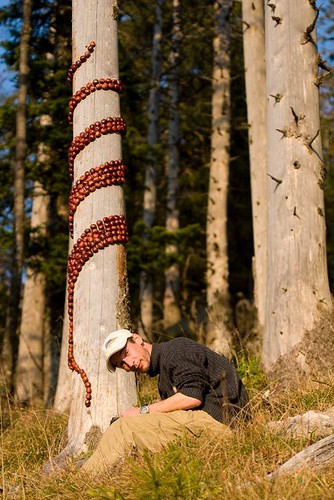
One creative artist, Sylvain Meyer, uses the term 'Land Art' to refer to his work with nature. Meyer's ephemeral designs have earned him quite a bit of recognition, and are reminiscent of the epic natural works of Andy Goldsworthy. The photo to the left shows Meyer in the process of creating one of his noteworthy pieces entitled "Enroulement Marron" or "Brown Swirl" in English. This piece was made out of brown chesnuts, which as Meyer says, are usually only picked up by children. In his works, Meyer is consistently remaining conscious of his effect on the environment around him, and is careful to use "eco-friendly" methods. Meyer's artwork brings to mind the simple play of a child. We all experienced something in the way of making our own mark in nature, whether it be a circle in the sand, a pile of stones, or twisting flowers together into a bracelet. Nature is something we can each relate to being inspired by because it's all around us.      When looking at 'creativity from without', as observers we often find ourselves trying to place meaning on pieces of work that simply isn't meant to be found. The point of work like this isn't to make a statement, boost an opinion, express an emotion, or define the artist. This kind of art is about working with material, enjoying the process, and more often than not, it's about creating something that is simply beautiful. Artwork like Meyer's and Goldworthy's is notable because it represents this type of creation in a natural and stunning way. What makes these artists unique isn't necessarily their talent or skill with their instruments, it is simply their inspiration from without.
Subscribe to:
Posts (Atom)
About Me

Featured Blogs
|